
Table of Contents
- What Should You Measure Before Moving Furniture Up a Staircase?
- 1. Measure the Furniture Before Measuring the Staircase
- 2. Measure the Staircase Width at Its Narrowest Points
- 3. Check the Headroom Above the Staircase
- 4. Measure the Landing and Turning Space
- 5. Check Handrails, Bannisters and Other Obstructions
- 6. Identify the Type of Staircase
- 7. Measure the Doorways at the Bottom and Top of the Stairs
- 8. Compare the Furniture Dimensions With the Complete Staircase Route
- 9. Common Mistakes When Measuring Staircases for Furniture
- 10. Dubai Apartment and Building Considerations
- 11. What Should You Do If the Furniture May Not Fit?
- Staircase Measurement Checklist
- Frequently Asked Questions
- Planning a Furniture Move in Dubai?
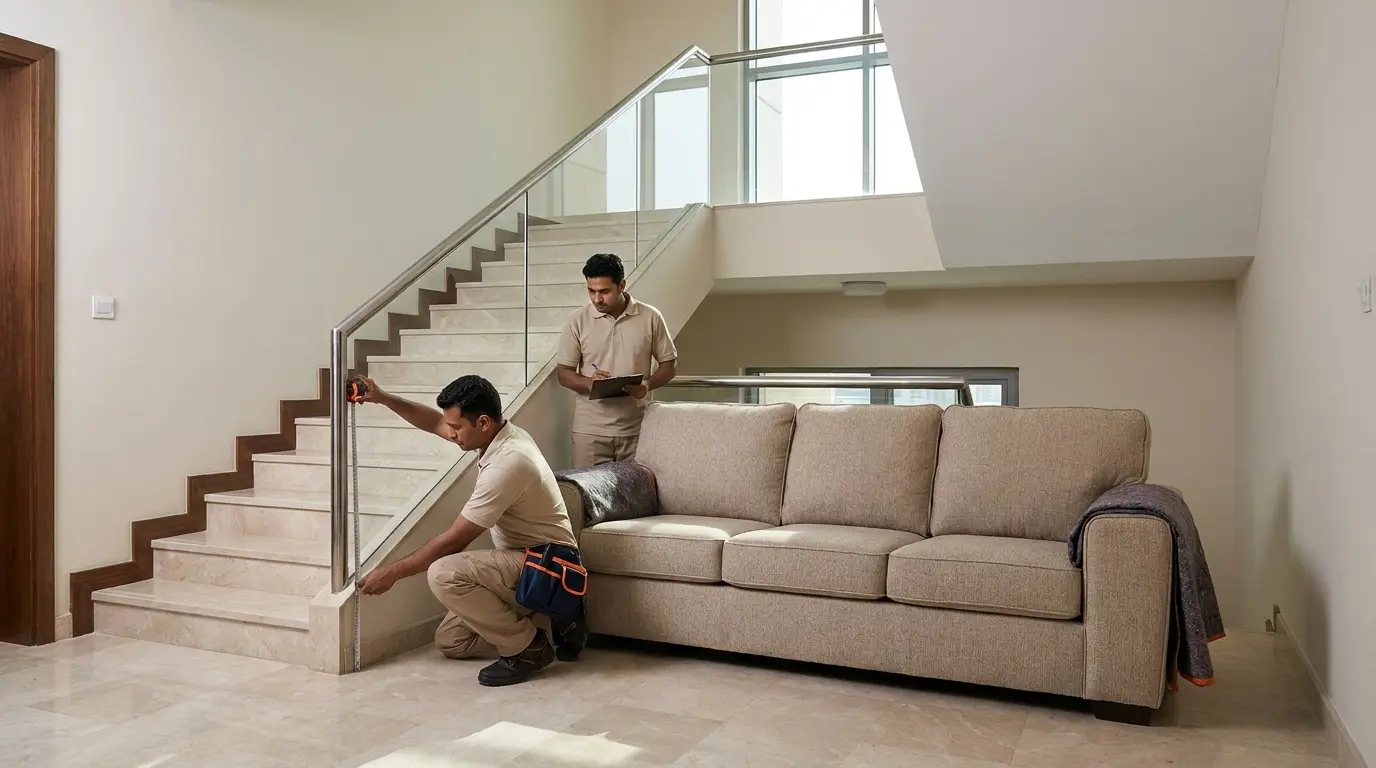
Before arranging a furniture move, measure the complete staircase route. This includes the width of each flight, the available headroom, landing dimensions, handrails, bannisters, doorways and any other fixed obstructions. You should also measure the furniture in the condition in which it will be carried.
The most important rule is to measure the narrowest usable clearance along the entire route, not just the width of one step. A piece of furniture must have enough room to move, tilt and turn through every section of the staircase.
This guide explains which measurements to take, how to record them and what to check before deciding whether a large item can be carried upstairs or downstairs.
What Should You Measure Before Moving Furniture Up a Staircase?
Before moving large furniture, measure these areas:
- Furniture dimensions: Record the item's height, width, depth and longest fixed section.
- Staircase width: Measure the usable distance between walls, handrails or bannisters at the narrowest points.
- Headroom: Check the vertical clearance above the steps and landings.
- Landing dimensions: Record the width and depth of every landing where the item may need to turn.
- Obstructions: Include handrails, newel posts, light fittings, beams, doors and other objects that reduce clearance.
- Doorways: Measure the clear opening at the bottom and top of the staircase.
- Turning space: Check whether the furniture can change direction without hitting the walls, ceiling or railing.
These measurements provide an initial assessment of the route. They do not automatically guarantee that an item will fit, because its shape, weight, orientation and handling requirements also matter.
1. Measure the Furniture Before Measuring the Staircase
Start with the furniture itself. You need accurate dimensions before comparing it with the available staircase space.
Measure the item in the condition in which it will be carried. If the furniture can be dismantled, identify which components can genuinely be removed and record the dimensions of the largest fixed section.
Record these measurements:
| Measurement | What to record |
|---|---|
| Height | The distance from the lowest to the highest point |
| Width | The widest horizontal measurement |
| Depth | The distance from the front to the back |
| Length | The longest dimension of the item |
| Diagonal | A relevant diagonal measurement across the item's profile |
| Weight | Approximate weight, if available |
Pay attention to parts that extend beyond the main body, including handles, feet, decorative edges, armrests, headboards and fixed frames.
Check removable parts
Some furniture can be made easier to manoeuvre by removing components. Check whether the following parts can be detached safely:
- Sofa legs and removable cushions.
- Bed-frame side rails, headboards and footboards.
- Table legs and detachable bases.
- Wardrobe doors, shelves and removable drawers.
- Separate modules of a sectional sofa.
Do not assume that a component is removable simply because it looks detachable. Check the manufacturer's instructions or confirm the construction before attempting to take it apart.
Measure the largest fixed section
When furniture is dismantled, the overall assembled dimensions may no longer be the most useful figures. Measure the largest individual section that still needs to pass through the staircase.
For example, a bed frame may separate into a headboard, side rails and slats. The headboard could be the largest component, so its dimensions should be checked against the route separately.
2. Measure the Staircase Width at Its Narrowest Points
The staircase width determines how much horizontal space is available while carrying the furniture.
Do not measure only from one wall to the other. The usable width is the space between the surfaces that actually restrict movement.
These may include:
- Handrails.
- Bannisters.
- Newel posts.
- Wall-mounted fixtures.
- Skirting boards.
- Decorative wall features.
- Other permanent obstructions.
Measure the staircase at several points:
- Near the bottom of the first flight.
- Around the middle of the flight.
- Near the top of the flight.
- At any turn or change in direction.
- At any point where a handrail or wall feature narrows the route.
Record the smallest usable measurement for each section.
Why the narrowest point matters
A staircase may appear wide at the bottom but become narrower near the top because of a handrail, projecting wall or structural feature.
A large item has to pass through the tightest section, not the average width of the staircase.
Also consider that furniture may need to be carried at an angle. A measurement taken only at floor level may not show whether the upper part of the item will collide with a railing or wall.
3. Check the Headroom Above the Staircase
Headroom is the clear vertical space above the stairs. It is especially important when moving tall or long furniture.
A piece may have enough room across the staircase but still become trapped beneath a low ceiling, beam or staircase structure.
Check the distance from the stair surface to the lowest obstruction above it.
Look for:
- Low ceilings.
- Beams and structural projections.
- The underside of another staircase.
- Low ceiling edges near an upper-floor opening.
- Hanging lights.
- Ceiling-mounted fixtures.
- Sloping ceilings.
Measure at several points along the flight, especially where the staircase passes below a floor or another flight of stairs.
Record the smallest headroom measurement.
Do not measure headroom at only one step
The available vertical clearance can change as you move up or down a staircase. A section may have comfortable headroom at the bottom but become restricted near the upper floor.
If a large item needs to be tilted, the space above the furniture also matters. A tall wardrobe or long tabletop may require a different carrying angle from a compact sofa.
4. Measure the Landing and Turning Space
A landing is a flat area between staircase flights or at a change in direction. It may be the most difficult part of the route for large furniture.
A straight staircase provides a relatively continuous path. A staircase with a landing requires the item to change direction, which can create additional clearance problems.
Measure:
- The landing's usable width.
- The landing's usable depth.
- The clear height above the landing.
- The distance between the walls and bannisters.
- The space available around newel posts.
- The distance to the next flight.
- Any doorway opening directly onto the landing.
Do not measure the landing from wall to wall if a handrail, door or fixed object reduces the usable area.
Check whether the furniture can turn
Imagine the item arriving at the landing in the same orientation in which it is being carried. Consider whether it can be rotated to face the next flight.
A long sofa may fit along the first flight but need additional space to turn onto the next one. A rigid wardrobe may be more difficult to rotate because it cannot change shape.
The landing must provide enough space for the item and the people handling it to reposition it safely.
Look above the landing too
A landing may have enough floor space but insufficient ceiling clearance to tilt the furniture.
Check for low ceilings, beams, stairwell openings and light fixtures. Both horizontal and vertical clearance affect whether an item can be repositioned.
5. Check Handrails, Bannisters and Other Obstructions
The staircase's usable space can be smaller than its visible floor area.
Walk the full route and identify anything that may interfere with the furniture.
| Obstruction | What to check |
|---|---|
| Handrails | How far they project into the staircase |
| Bannisters | Whether they restrict the width or turning space |
| Newel posts | Whether they create a tight corner |
| Wall lights | Whether they reduce clearance |
| Ceiling lights | Whether they restrict headroom |
| Beams | Their lowest point above the route |
| Doors | Whether the door leaf reduces landing space |
| Wall features | Shelves, frames or other fixed projections |
Do not remove, loosen or alter building fixtures without permission. A handrail or bannister may be part of the building's safety provisions.
If a removable obstruction appears to affect the route, confirm with the property owner or building management whether it can be safely and lawfully removed.
6. Identify the Type of Staircase
Different staircase layouts create different challenges. The same furniture dimensions may be manageable on one staircase but difficult to manoeuvre on another.
Straight staircase
A straight staircase has a single continuous flight without a turn between floors.
Check the width, headroom, handrails and clearance at the top and bottom. Long furniture may be easier to position on a straight route, but low ceilings and narrow doorways can still prevent passage.
L-shaped staircase
An L-shaped staircase changes direction, usually by approximately 90 degrees, at a landing.
Measure the landing carefully. Check whether the furniture can rotate around the corner and whether there is enough height to tilt it if necessary.
U-shaped staircase
A U-shaped staircase has two flights that travel in opposite directions, connected by a landing.
Check the landing depth, width and ceiling clearance. The distance between the two flights and the available turning space can affect how a large item is repositioned.
Spiral staircase
A spiral staircase curves around a central support. Its usable width may vary across individual steps, and the turning path can be restrictive.
Measure the narrowest usable part of the steps, the distance around the central post and the clearance above the staircase. A large rigid item may be particularly difficult to manoeuvre through this type of route.
Winder staircase
A winder staircase uses wedge-shaped steps to change direction instead of a full rectangular landing.
Measure the usable width at the turning section and identify the tightest points around the inside of the turn. Do not assume that the item can rotate in the same way it could on a flat landing.
7. Measure the Doorways at the Bottom and Top of the Stairs
The staircase is only one part of the route. Furniture also needs to pass through the doors and openings connected to it.
Measure the clear opening at both ends of the staircase.
Record:
- Clear doorway width.
- Clear doorway height.
- Door-frame projections.
- Available space immediately before the doorway.
- Available space immediately after the doorway.
- Door swing direction.
- Any nearby wall, cabinet or fixed obstruction.
A doorway may have sufficient width when measured on its own but still be difficult to use if the furniture cannot be straightened or rotated before reaching it.
Check the route from the collection room to the staircase and from the top or bottom of the stairs to the destination room.
8. Compare the Furniture Dimensions With the Complete Staircase Route
Once you have measured the furniture and staircase, compare the figures section by section.
Do not compare only the furniture width with the staircase width. The furniture may need to be tilted, turned or carried at an angle.
For each section, consider:
- The furniture's longest dimension.
- Its height and depth.
- The available staircase width.
- Headroom above the steps.
- The space available to change its orientation.
- The shape of the item.
- Whether any parts can be removed.
- Whether the item can be handled safely.
Example: Checking a large sofa
Imagine a sofa with these approximate dimensions:
| Furniture measurement | Example size |
|---|---|
| Length | 210 cm |
| Depth | 90 cm |
| Height | 85 cm |
Now imagine the staircase has a narrow flight, a 90-degree landing and a low ceiling near the upper floor.
Even if the sofa appears narrower than the staircase, it may still be difficult to turn at the landing or tilt beneath the ceiling.
The correct assessment needs to consider the sofa's dimensions in different orientations and the available clearance at every point.
These figures are illustrative only. They are not a universal fit formula or a guarantee that a sofa of this size will pass through a particular staircase.
9. Common Mistakes When Measuring Staircases for Furniture
A few overlooked details can make an otherwise careful measurement unreliable.
Measuring only the first few steps
The narrowest point may be near the top, at a turn or beside a handrail. Check the full route.
Ignoring headroom
A tall item may have enough horizontal space but collide with the ceiling or underside of another staircase.
Forgetting the landing
A sofa or wardrobe may travel along a flight but become trapped when it needs to turn.
Measuring wall-to-wall instead of usable width
Handrails, bannisters and other projections reduce the space available for furniture.
Ignoring the doorways
The top or bottom doorway may be narrower than the staircase itself.
Using assembled dimensions after dismantling
If furniture can be separated into components, measure the largest fixed section rather than relying only on its assembled size.
Assuming that a diagonal position will solve everything
Tilting furniture can sometimes help, but it also changes the clearance needed above and around the item. Do not assume that an item will fit simply because it can be turned diagonally.
Relying on approximate measurements
If the measurements are close, repeat them carefully and record the smallest clearance. Do not treat an exact match as proof that the item can pass safely.
10. Dubai Apartment and Building Considerations
In Dubai, staircase access may depend on the property layout and building management requirements.
Before planning a furniture move, check whether the building allows furniture to be carried through the staircase and whether there are restrictions on using shared areas.
Confirm the following with the relevant building management:
- Whether the staircase can be used for furniture transportation.
- Whether a service lift must be used instead.
- Whether prior approval or a moving permit is required.
- Whether there are designated moving hours.
- Whether protective coverings are required in common areas.
- Whether a loading area or parking arrangement must be booked.
- Whether any restrictions apply to large or bulky items.
Requirements vary between properties and communities. For example, Emaar Community Management's published rules for Downtown Dubai specify procedures for furniture deliveries and removals, including directions from the Community Manager and restrictions on using passenger lifts without prior written consent. Always check the rules that apply to your own building rather than assuming that another property's policy applies to you.
COMMUNITY MANAGEMENT
11. What Should You Do If the Furniture May Not Fit?
If the measurements suggest that the furniture may not pass through the staircase, do not force it.
Consider these steps:
- Recheck the measurements. Confirm the narrowest width, lowest headroom and landing dimensions.
- Check removable components. Determine whether legs, doors, cushions or other parts can be safely detached.
- Review the furniture's orientation. Consider whether a different carrying position is possible without creating an unsafe handling situation.
- Check another approved route. Ask whether a suitable service lift or alternative access route is available.
- Consult the building management. Confirm whether the staircase and any alternative route can be used.
- Request a professional assessment. If the item is large, heavy or difficult to turn, have the route and handling requirements reviewed before arranging the move.
Do not force furniture through a tight space, overload a staircase or remove fixed building fittings to create clearance. If the route remains uncertain, resolve the issue before the moving date.
Staircase Measurement Checklist
Use this checklist when inspecting a staircase before moving a large item.
| Check | Measurement or detail recorded |
|---|---|
| ☐ | Furniture height, width, depth and length |
| ☐ | Dimensions of the largest fixed furniture section |
| ☐ | Narrowest usable width of the first flight |
| ☐ | Narrowest usable width of every other flight |
| ☐ | Lowest headroom above the staircase |
| ☐ | Landing width and depth |
| ☐ | Clear height above each landing |
| ☐ | Space around handrails and bannisters |
| ☐ | Newel posts and other fixed obstructions |
| ☐ | Doorway width and height at both ends |
| ☐ | Available space to turn the furniture |
| ☐ | Building management access requirements |
Take photographs of the staircase from the bottom, top and each landing. Include close-up photographs of tight turns, low ceilings and any obstructions.
Keep the photographs with the measurements so the route can be reviewed before the furniture is moved.
Frequently Asked Questions
How do I measure a staircase before moving furniture?
Measure the usable width of each staircase flight, the headroom above the steps, the width and depth of each landing, and the clear openings at the top and bottom. Include handrails, bannisters and other obstructions. Compare these measurements with the furniture's dimensions in the condition in which it will be carried.
What is the most important staircase measurement for moving a sofa?
There is no single measurement that proves a sofa will fit. The narrowest usable width, headroom and landing turning space all matter. The sofa's length, depth, height and ability to change orientation must also be considered.
Should I measure staircase width between the walls or handrails?
Measure the usable clearance between the surfaces that actually restrict the furniture. If a handrail, bannister or other fixed feature projects into the staircase, include it when recording the available width.
How do I measure a staircase landing for large furniture?
Record the landing's usable width and depth, as well as the clear height above it. Check the space around the handrails, posts and doorways. Consider whether the furniture can rotate from one flight to the next without colliding with the walls or ceiling.
Can a large sofa fit around an L-shaped staircase?
It depends on the sofa's dimensions, shape, the landing size and the available headroom. A sofa may fit along the first flight but be unable to rotate around the landing. Measure the complete turning area before deciding.
Are spiral staircases suitable for moving large furniture?
Spiral staircases can be restrictive because the steps curve around a central support and the usable width varies. Large or rigid furniture may be difficult to manoeuvre. Measure the narrowest points and turning clearance, and seek an assessment if the fit is uncertain.
Should I measure furniture before or after dismantling it?
Measure it in the condition in which it will be carried. If parts can be safely detached, record the dimensions of the largest fixed components separately. Confirm whether dismantling is possible before relying on reduced dimensions.
What should I do if the furniture is almost the same size as the staircase?
Do not assume that a close or exact measurement is sufficient. Recheck the narrowest points, headroom, landing and doorways. Furniture needs room to be manoeuvred, and the carrying angle can change the clearance required. Seek a professional assessment if the route remains uncertain.
Do Dubai buildings allow furniture to be carried through staircases?
Building rules vary. Some properties may require a service lift, prior approval or specific moving arrangements. Contact the building management to confirm whether staircase access is permitted for your furniture and what procedures apply.
Planning a Furniture Move in Dubai?
Measuring the staircase before arranging a collection or delivery can help identify access problems early. Share the furniture dimensions, staircase photographs and details of any narrow turns or low-clearance areas when discussing your requirements.
If you are arranging transportation for a sofa, bed or another individual furniture item, you can explore our furniture pickup and delivery service or review the relevant sofa moving requirements.
Contact Single Item Movers Dubai to discuss your item, collection location, destination and access details.
Staircase dimensions, building access rules and furniture handling requirements vary between properties. Always verify the actual measurements and permissions before confirming a move.