
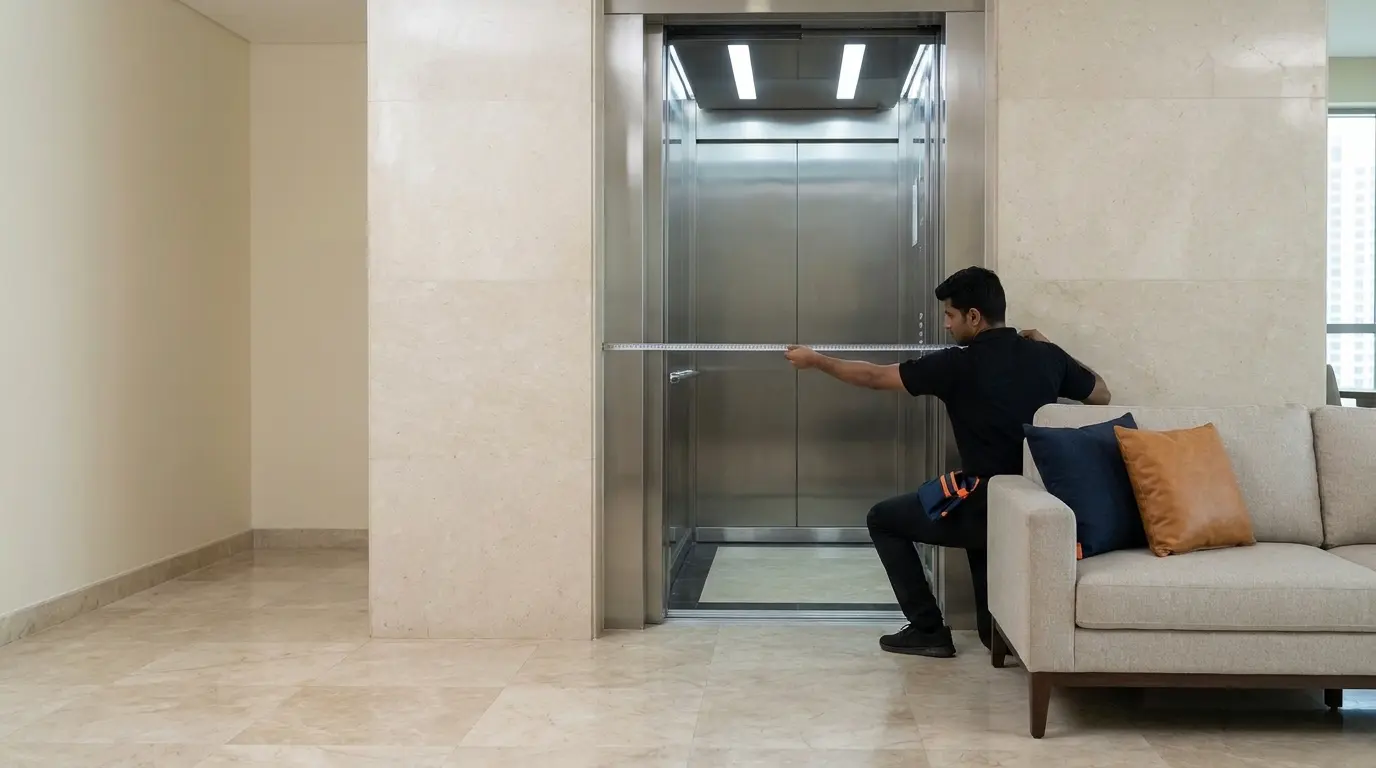
How Can You Check Whether Furniture Will Fit in a Lift?
To check whether furniture will fit in a lift, compare the furniture's actual transport dimensions with the lift's clear door opening and internal cabin dimensions. Measure the furniture's height, width and depth, then measure the lift-door width and height, cabin width, depth and height.
Also consider:
- Whether the furniture can be tilted or rotated.
- Whether its legs, arms or other parts can safely be removed.
- Whether the lift has handrails or other internal obstructions.
- Whether the furniture's weight is within the lift's permitted capacity.
- Whether the building allows furniture transportation in that particular lift.
The important point: A furniture item must fit through the lift entrance and occupy a workable position inside the cabin. Passing the entrance alone does not guarantee that it will fit.
1. Measure the Furniture Before Checking the Lift
Start by measuring the item you intend to transport. Do not rely only on the dimensions shown in a product photograph or online listing.
Use a measuring tape and record the maximum dimensions of the furniture.
| Measurement | What to measure |
|---|---|
| Height | Floor to the highest point |
| Width | Widest side of the item |
| Depth | Front to back |
| Length | Longest overall side |
| Diagonal depth | Useful for checking angled movement |
| Weight | Total weight or the heaviest individual component |
Include fixed handles, arms, feet, decorative edges and other projections that cannot be removed.
Measure furniture in its transport condition
Furniture may be transported assembled, partially dismantled or in separate sections.
For example:
- A sofa may have detachable legs or removable cushions.
- A bed frame may be separated into a headboard, side rails and slats.
- A wardrobe may have removable shelves or drawers.
- A dining table may have detachable legs.
- A sectional sofa may separate into individual modules.
Ask the manufacturer or seller which parts can safely be removed. Never assume that a component is detachable simply because it looks removable.
If the furniture arrives in a carton, ask for the dimensions of the largest individual package. The assembled furniture dimensions will not necessarily represent the dimensions that need to pass through the lift.
2. Measure the Lift Door Opening
The lift entrance is one of the first restrictions to check.
Open the lift doors fully and measure the usable opening, rather than relying on the outside frame dimensions.
Record:
Clear door width: Measure horizontally between the usable left and right edges of the opening.
Clear door height: Measure vertically from the lift floor to the lowest point at the top of the opening.
Check for anything that reduces the available clearance, including door frames, projecting fittings and other fixed features.
A furniture item that is wider than the opening in its normal position may sometimes pass at an angle. However, this depends on its shape, rigidity and the space available on both sides of the entrance.
Do not force an item through an opening where it has almost no clearance.
3. Measure the Internal Lift Cabin
The lift door and the lift cabin are two different measurements. You need both.
Measure the inside of the lift at its usable points.
| Lift measurement | Why it matters |
|---|---|
| Internal width | Determines the available side-to-side space |
| Internal depth | Shows how far the furniture can extend into the cabin |
| Internal height | Helps assess whether long furniture can stand upright |
| Floor diagonal | Helps assess possible angled positioning |
| Door width | Determines the entrance clearance |
| Door height | Determines vertical entrance clearance |
Remember to account for handrails, mirrors, control panels, lighting fixtures and other permanent fittings.
For example, a cabin may appear wide enough when measured wall to wall, but a handrail can reduce the usable space at the point where the furniture needs to pass.
If you cannot safely measure the cabin yourself, ask building management for its official dimensions and permitted load capacity.
4. Check Whether Long Furniture Can Fit Diagonally
Some furniture items are too long to fit horizontally but may fit when placed at an angle.
This is particularly relevant to:
- Three-seater sofas
- L-shaped sofa sections
- Wardrobes
- Bed headboards
- Dining tables
- Long cabinets
- Large mirrors and panels
A diagonal position can make better use of the available floor space, but it does not automatically solve every clearance problem.
Check the furniture's dimensions in the intended carrying position. Then consider the available floor diagonal, cabin height, door opening and space needed to rotate the item.
Example: A long sofa
Imagine a sofa measuring:
- Length: 210 cm
- Depth: 85 cm
- Height: 80 cm
These are hypothetical dimensions, not standard sofa measurements.
If the lift is shorter than the sofa's length, the sofa may not fit lying flat. It might still be possible to position it at an angle or stand it on an end, but this depends on the cabin's internal dimensions and the sofa's shape.
The correct approach is to assess the complete three-dimensional position rather than compare only the sofa's length with the lift's depth.
Do not assume that a diagonal floor measurement alone proves that an item will fit. The entrance, cabin ceiling and available rotation space must also be considered.
5. Check the Furniture's Weight Against the Lift Capacity
Dimensions are only one part of the assessment. Weight matters too.
Every lift has a permitted load capacity, usually displayed inside the cabin or documented by building management.
Before transporting heavy furniture, check:
- The furniture's approximate weight.
- The number of people who will be inside the lift.
- The weight of any moving equipment.
- The lift's permitted total load.
- Any building-specific restrictions.
The posted capacity applies to the total load, not just the furniture.
For example, a heavy stone-top dining table may fit dimensionally but still be unsuitable for the lift when combined with the people and equipment needed to carry it.
Never exceed the displayed capacity or attempt to bypass the lift's safety controls.
6. Check the Space Outside the Lift
Furniture does not travel directly from the apartment door into the lift in every building.
There may be a lobby, corridor, corner or narrow entrance between the apartment and the lift.
Check:
- Corridor width.
- Distance between the lift entrance and nearby walls.
- Available turning space.
- Door swings and door closers.
- Low ceilings and ceiling fixtures.
- Columns and other fixed obstructions.
- The space required to turn the furniture before entering the lift.
A long sofa may pass through the lift entrance but become stuck when the person carrying it needs to rotate it inside the cabin.
This is why measuring the lift alone is not always enough.
7. Check Dubai Building Rules Before Arranging Delivery
Apartment buildings in Dubai can have different delivery and moving procedures.
Some buildings require residents to reserve a service lift, obtain permission or follow specific delivery hours.
Before arranging furniture transportation, contact building management and ask:
- Which lift is approved for furniture deliveries?
- Does the building have a separate service or goods lift?
- Does the lift need to be booked in advance?
- Is a move-in or delivery permit required?
- Are protective coverings required?
- What are the permitted delivery hours?
- Is there a designated loading or unloading area?
- Are there any restrictions on furniture size or weight?
For example, Emaar's Downtown Dubai community rules specify designated loading arrangements and service elevators for furniture and bulky-item movements. Certain large deliveries and removals require advance permission. These requirements apply to the relevant Emaar community and should not be assumed to apply identically to every Dubai building.
Central Park Towers at DIFC also documents separate elevator groups for different building areas and functions.
Always confirm the actual arrangements with your own building management rather than relying on another building's rules.
8. What If the Furniture Does Not Fit in the Lift?
If your measurements suggest that the furniture will not fit, do not force it into the lift.
Consider the following options:
Check removable components
Ask the furniture manufacturer or seller whether legs, arms, shelves, drawers or other components can be safely removed.
Check whether the item is modular
Some sofas, beds and cabinets are designed to be transported in separate sections. Confirm the actual dimensions of each section.
Ask about an approved alternative lift
Your building may have a larger service or goods lift. Ask management whether it is available and approved for your delivery.
Check the staircase
If lift access is unsuitable, ask whether the staircase offers a safe and permitted alternative. Measure the stair width, landing depth, turning space and ceiling clearance before considering this option.
Consider professional assessment
For unusually large, heavy or delicate furniture, arrange an assessment before collection. Do not attempt risky lifting or dismantling simply to make an item fit.
Never remove fixed building fittings, alter lift doors or use an external lifting method without the necessary permissions and qualified professionals.
Furniture and Lift Measurement Checklist
Use this checklist before purchasing furniture or confirming a delivery.
| Check | Completed |
|---|---|
| Measured furniture height, width and depth | ☐ |
| Checked the furniture's weight | ☐ |
| Confirmed removable parts with the manufacturer | ☐ |
| Measured lift-door clear width | ☐ |
| Measured lift-door clear height | ☐ |
| Measured internal cabin width | ☐ |
| Measured internal cabin depth | ☐ |
| Measured internal cabin height | ☐ |
| Checked diagonal positioning where relevant | ☐ |
| Checked lift load capacity | ☐ |
| Checked corridor and turning space | ☐ |
| Confirmed approved lift and booking requirements | ☐ |
Keep the measurements together with clear photographs of the furniture and the lift. This makes it easier to discuss any potential access problems before delivery.
Frequently Asked Questions
How do I know if my sofa will fit in a lift?
Measure the sofa's length, depth and height, then compare them with the lift-door opening and internal cabin dimensions. If the sofa is long, consider whether it can safely be positioned diagonally or vertically without hitting the cabin ceiling or walls.
Should I measure the lift door or the inside of the lift?
Measure both. The furniture must pass through the clear door opening and fit inside the cabin. A sufficiently wide door does not guarantee enough internal depth or height.
Can a long sofa fit in a small lift?
It depends on the sofa's dimensions, shape and available cabin space. Some sofas may fit when positioned diagonally or vertically, while others may be too long or bulky. Check all relevant dimensions before delivery.
Does lift capacity include people and furniture?
Yes. The displayed maximum load applies to the combined load inside the lift. Account for the furniture, people and any equipment, and never exceed the permitted capacity.
Can I use a passenger lift for furniture delivery in Dubai?
Not necessarily. Building management may require the use of a designated service or goods lift. Ask for permission before using a passenger lift for bulky furniture.
What should I do if my furniture cannot fit in the lift?
Check whether the furniture has manufacturer-approved removable components, whether a larger approved service lift is available, or whether a safe and permitted staircase route exists. For difficult items, arrange a professional assessment before delivery.
Should I book the service lift before arranging furniture delivery?
If your building requires a reservation, confirm the lift slot before finalising the delivery schedule. Also check any permit, loading-area, protective-covering and timing requirements.
Planning a Furniture Collection or Delivery in Dubai?
Before arranging a furniture move, make sure the item's dimensions and building access details are available.
Single Item Movers Dubai can receive enquiries for individual furniture items and pickup or delivery requirements. Share the item photograph, approximate dimensions, pickup and delivery locations, floor numbers and lift information so the requirements can be discussed.
You can also explore our furniture pickup and delivery service for relevant service information.
Call: +971 58 145 3213
WhatsApp: https://wa.me/971581453213