
How to Measure Furniture Before Moving It in Dubai
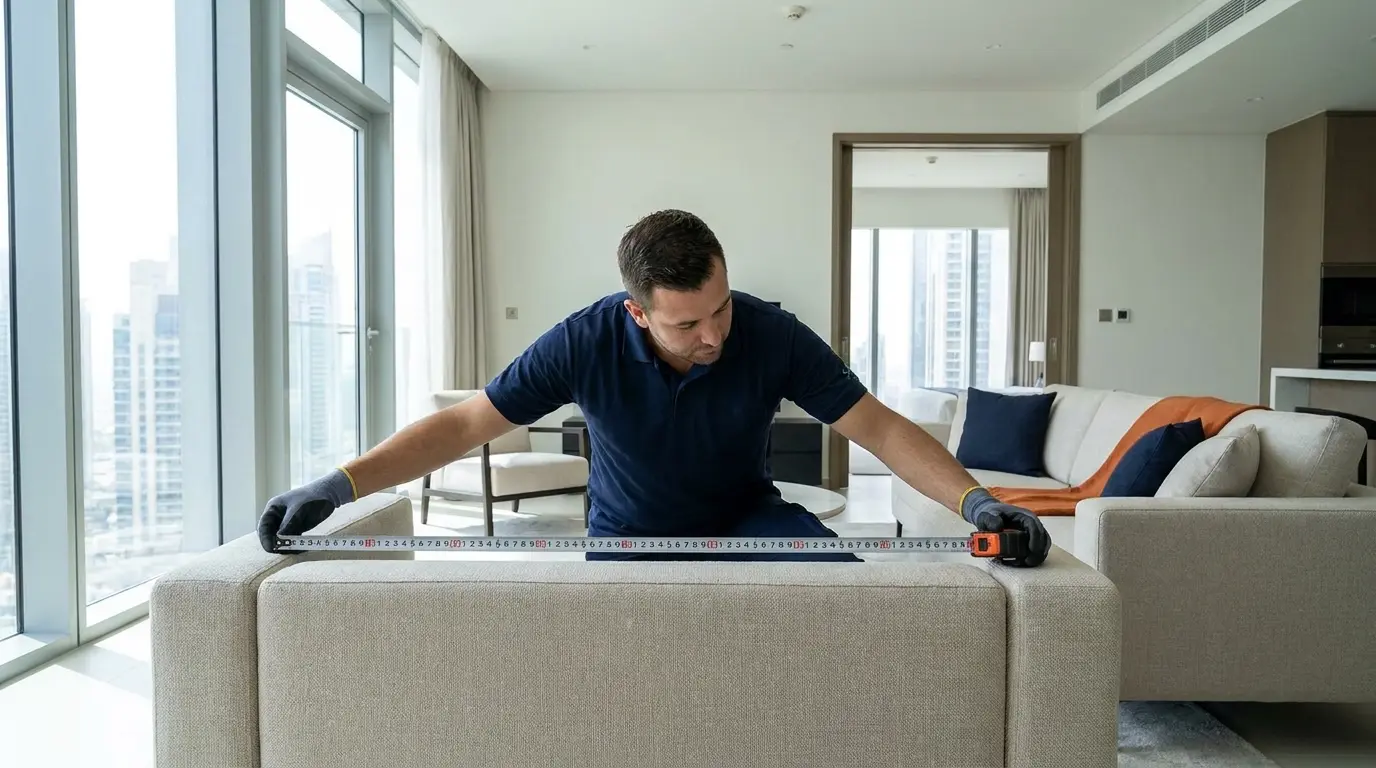
Table of Contents
- 1. Measure the Furniture Correctly
- 2. Measure the Room Where the Furniture Will Go
- 3. Measure the Complete Access Route
- 4. Compare Furniture Dimensions With Access Measurements
- 5. Record Photos and Measurements
- 6. Common Furniture Measurement Mistakes
- 7. Furniture Measurement Checklist
- Frequently Asked Questions
- Conclusion
The short answer: Measure the furniture's length, width, height and depth. Then measure the usable width and height of every doorway, hallway, lift entrance, staircase and landing along the route. Finally, compare the measurements and check whether the furniture has enough space to turn and reach its final position.
1. Measure the Furniture Correctly
Start with the furniture itself. Use a measuring tape and record dimensions in centimetres. Measure the widest, tallest and deepest points rather than estimating from appearance.
Length, width and height
For most furniture, record these three basic measurements:
- Length: The longest horizontal measurement from one end to the other.
- Width: The measurement across the furniture from front to back or side to side, depending on its shape.
- Height: The measurement from the floor to the highest point.
The correct direction depends on the furniture's design. For example, a dining table, wardrobe and sofa have different shapes, so record the dimensions in a consistent way and label each measurement clearly.
Depth and diagonal depth
Depth is particularly useful when checking whether bulky furniture can pass through a narrow doorway.
For sofas and upholstered chairs, also check the diagonal depth where relevant. This helps when assessing whether an item may need to be tilted or turned while passing through an opening.
Do not assume that a piece will fit simply because one of its measurements is smaller than the doorway width. Its shape, orientation, height and available turning space all matter.
Check removable parts and packed dimensions
Some furniture has detachable legs, removable cushions, separate sections or other components. Record the dimensions in the configuration in which the item will actually be transported.
If the furniture is packed in a carton, use the external package dimensions rather than the furniture's assembled dimensions.
Do not assume that a structural part can be removed. Confirm this with the manufacturer, seller or relevant furniture professional first.
2. Measure the Room Where the Furniture Will Go
Furniture needs to fit its destination, not just the route leading to it.
Measure the area where you plan to place the item and check the available floor and wall space.
Consider:
- The available wall length.
- The distance between nearby furniture.
- Space needed to open doors and drawers.
- Space needed to walk around the furniture.
- Nearby electrical outlets, switches and fixed fittings.
- Whether the item will block a doorway or normal walking route.
One practical method is to mark the furniture's approximate footprint on the floor using removable painter's tape. This gives you a better visual idea of how much space it will occupy.
For a more accurate layout, check the actual dimensions supplied by the manufacturer or seller. Furniture described as a particular size or style may have different dimensions between models.
3. Measure the Complete Access Route
This is one of the most important parts of furniture measurement.
Do not measure only the front door. Walk the complete route from the furniture's current location to the destination room.
A route may include:
- Building entrance.
- Lobby or reception area.
- Lift or elevator.
- Hallway.
- Internal doorway.
- Staircase and landing.
- Final room entrance.
Measure each relevant point and identify the narrowest opening or most difficult turn.
Building entrance and doorways
Measure the usable opening of every doorway the furniture must pass through.
Record:
- Clear doorway width.
- Clear doorway height.
- Door opening direction.
- Handles and other projecting fittings.
- Space available immediately before and after the doorway.
Measure the usable opening with the door in the position it will be used. The door frame's overall external size is not necessarily the space available for furniture.
Also consider whether the item needs to be tilted or rotated. A straight measurement alone may not establish whether a bulky piece can turn through the entrance.
Hallways and corners
Measure the narrowest part of every hallway.
Check for:
- Wall projections.
- Handrails.
- Fixed cabinets.
- Decorative features.
- Low ceilings.
- Sharp corners.
- Limited turning space.
A furniture item may pass through a doorway but become difficult to manoeuvre at the next corner.
If the route includes a sharp turn, measure the available space on both sides of the corner. Take a photograph so the layout can be reviewed alongside the measurements.
Lifts and elevators
For an apartment building, measure both the lift entrance and the internal cabin.
Record:
- Lift door width.
- Lift door height.
- Internal cabin width.
- Internal cabin depth.
- Internal cabin height.
- Any handrails or fixed obstructions.
- Available space immediately outside the lift.
Do not assume that a wide lift entrance means the furniture will fit inside the cabin.
If your building has a service or goods lift, ask building management whether it can be used and whether a booking or approval is required. Building procedures vary, so confirm the details with the relevant management team.
Staircases and landings
If the furniture needs to travel by stairs, measure more than the staircase width.
Check:
- Clear staircase width.
- Handrail and banister projections.
- Ceiling height above the steps.
- Landing width and depth.
- Space at the top and bottom of the staircase.
- Turning clearance at each landing.
A staircase may be wide enough for a piece of furniture to pass in a straight line but still have insufficient space for a turn.
Furniture handling on stairs can involve additional risks. Do not attempt an unsafe lift or assume that an item can be tilted through a restricted space based only on measurements.
4. Compare Furniture Dimensions With Access Measurements
After recording all measurements, compare the furniture dimensions with each access point.
A simple comparison table can help:
| Measurement | Furniture | Access point |
|---|---|---|
| Width | Item width | Doorway clear width |
| Height | Item height | Doorway clear height |
| Depth | Item depth | Hallway or lift depth |
| Turning space | Item orientation and shape | Corner or landing clearance |
| Overall route | Largest item dimensions | Every route checkpoint |
Remember that furniture may need to pass through an opening in a different orientation. A piece that appears too wide when measured straight across may have another possible orientation, but that depends on its dimensions and available turning space.
Do not treat an exact measurement match as proof that the furniture will fit. Handles, protective wrapping, hands used for carrying and the space needed to manoeuvre can all affect usable clearance.
If the measurements are close, ask the relevant moving team or furniture professional to review the dimensions and photographs before making a final decision.
5. Record Photos and Measurements
Written measurements are more useful when supported by clear photographs.
Take pictures of:
- The furniture from the front.
- The furniture from the side.
- Any unusually wide or tall sections.
- The main entrance.
- Narrow hallways and corners.
- The lift entrance and cabin, if applicable.
- Staircases and landings.
- The destination room.
Keep the measurements in one note or document. Label each photograph so it is clear which doorway or access point it represents.
When discussing furniture pickup and delivery arrangements, you can share the item dimensions, collection and delivery locations, and relevant access information to help explain your requirements.
6. Common Furniture Measurement Mistakes
Avoid these mistakes when preparing for a furniture move:
- Measuring only the room: The item also needs to pass through every access point.
- Ignoring the lift: The entrance and internal cabin dimensions are different measurements.
- Forgetting corners: Turning space can be as important as doorway width.
- Using approximate dimensions: Record actual measurements wherever possible.
- Ignoring fixed obstacles: Handles, handrails, lights and wall projections can reduce clearance.
- Assuming furniture can be dismantled: Confirm removable components before planning around them.
- Not checking the final room: Furniture must fit its intended position as well as the access route.
- Relying on photographs alone: Photos help explain the layout, but they do not replace measurements.
7. Furniture Measurement Checklist
Use this checklist before arranging collection or delivery.
| What to check | Completed |
|---|---|
| Furniture length recorded | ☐ |
| Furniture width recorded | ☐ |
| Furniture height recorded | ☐ |
| Furniture depth recorded | ☐ |
| Removable parts identified | ☐ |
| Destination room measured | ☐ |
| Building entrance measured | ☐ |
| Internal doorways measured | ☐ |
| Hallways and corners checked | ☐ |
| Lift entrance and cabin measured | ☐ |
| Staircase and landings checked | ☐ |
| Access photographs taken | ☐ |
| Building access requirements confirmed | ☐ |
Keep the measurements and photographs together so they can be shared when discussing the move.
Frequently Asked Questions
How do I measure furniture before moving it?
Use a measuring tape to record the furniture's length, width, height and depth. Then measure the complete route, including doorways, hallways, lifts, stairs and the destination room.
Should I measure furniture before buying it?
Yes. Check the furniture dimensions and compare them with your available room space and access route before confirming a purchase.
How do I know if furniture will fit through a doorway?
Measure the usable doorway width and height, then compare them with the furniture's dimensions and possible carrying orientations. Also check the available space around the doorway for turning.
Do I need to measure the lift before moving furniture?
Yes, if the route involves an elevator. Measure the lift entrance separately from the internal cabin width, depth and height.
Why should I measure hallways and corners?
Furniture may fit through a doorway but still be unable to turn through a narrow corridor or around a landing. Measuring the entire route helps identify these potential restrictions.
What should I send before arranging furniture collection?
Share the furniture type, approximate dimensions, collection and delivery locations, property type and relevant information about stairs, lifts, parking and restricted access.
Can furniture be moved if it does not fit through the door?
It depends on the item's design, whether any parts can safely be removed, the available alternative route and the space available for handling. Do not assume dismantling or tilting will solve the problem without checking first.
Conclusion
Measuring furniture before moving it is about more than knowing its size. You also need to understand the space available along the entire route, from the original room to the final destination.
Record the furniture dimensions, check doorways and access points, measure lifts and staircases where necessary, and keep photographs of any difficult areas. A little preparation can help identify potential problems before collection day.
If you are planning to move an individual furniture item in Dubai, you can share its dimensions, photographs and pickup and delivery details with Single Item Movers Dubai. Contact the team on +971 58 145 3213 or send your enquiry on WhatsApp to discuss your requirements.